Flight Paramedic Grows Relationship Between LifeFlight of Maine and the Maine Army National Guard
Greg Milliken still recalls the first time he considered becoming a flight paramedic. He was taking an EMT class at a municipal airport in Marshfield, Massachusetts when he saw a medical helicopter land at the airport to refuel.
“I remember looking out the window and saying to myself, ‘that is something I would really love to do in the future,’” shared Greg, who is now a flight paramedic and clinical educator at LifeFlight of Maine and a Platoon Sergeant and Senior Medical Instructor at the Maine Army National Guard.
However, as Greg looked out the window all those years ago, he considered a role as a flight paramedic to be a big stretch. The idea of teaching others the skills needed to become a flight paramedic wasn’t even on his radar.
Greg first began working in EMS as a member of the University Volunteer Ambulance Corps at the University of Maine. While in Orono, he studied mechanical engineering, with plans to join the Air Force as a fighter pilot.
However, like most things, life didn’t go as planned. During school, Greg’s passion for EMS grew, and recruiters with the Maine Army National Guard reached out and asked if he would be interested in becoming a flight medic. In 2009, he completed the required training and joined the Guard.
“I thought it was a really great way to bridge the gap between my fascination with aviation and my new fascination with pre-hospital medicine,” said Greg. “It seemed like if I wanted to eventually work at a place like LifeFlight of Maine, then getting some experience as a flight medic would bolster my resume and make that more of a possibility.”
In 2018, after almost a decade in the Guard, Greg was deployed to Afghanistan. There, he saw first-hand the need for more training among Army flight medics. “I was deployed with a lot of people who had gone from having no real-world medical experience to having this huge credential, and their first real medical experience was overwhelming,” remembered Greg.
When he returned home, Greg watched many flight medics leave his unit.
“A lot of people left medicine entirely because I think they carried a lot of guilt with them associated with the realization that they had put themselves in a position that they weren’t prepared for,” shared Greg.
Looking back on his deployment, Greg said at the time he had considered himself a competent clinician. “I felt comfortable in those skills. But in reality, having worked at LifeFlight of Maine now, I realized that I, too, was woefully underprepared to do that job.”
Moving forward, he knew he wanted to make a change so future flight medics in the Guard would be better prepared to care for service members in battle.
“As a service to these service members, I want to give them a better toolbox to work from,” said Greg.
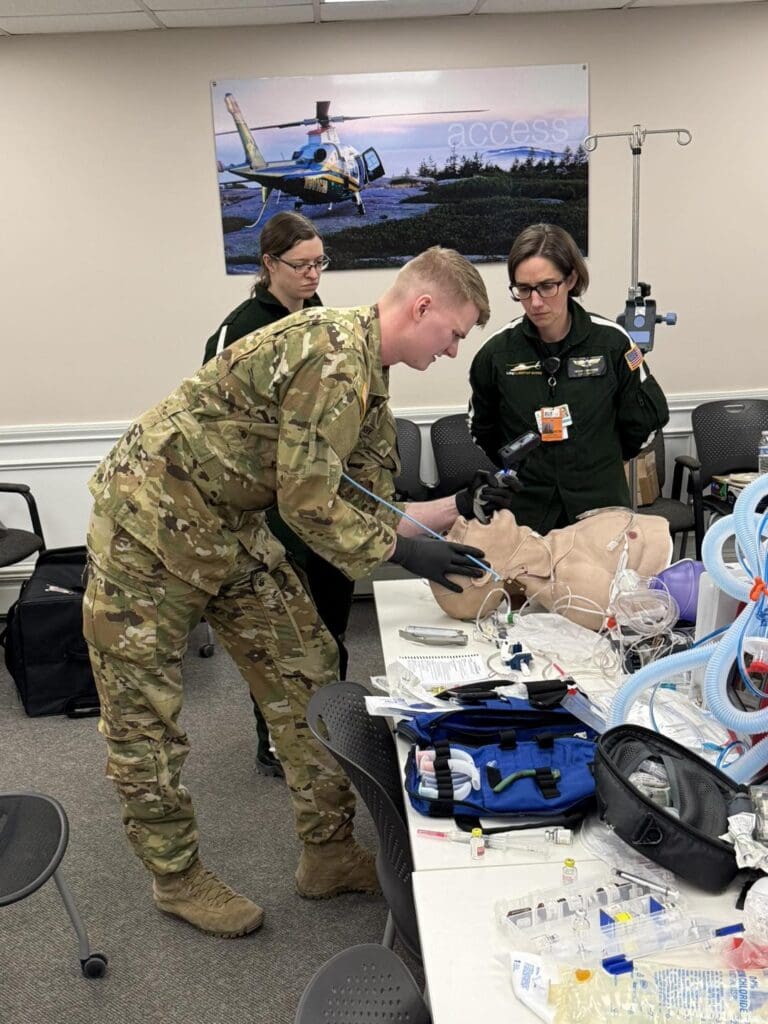
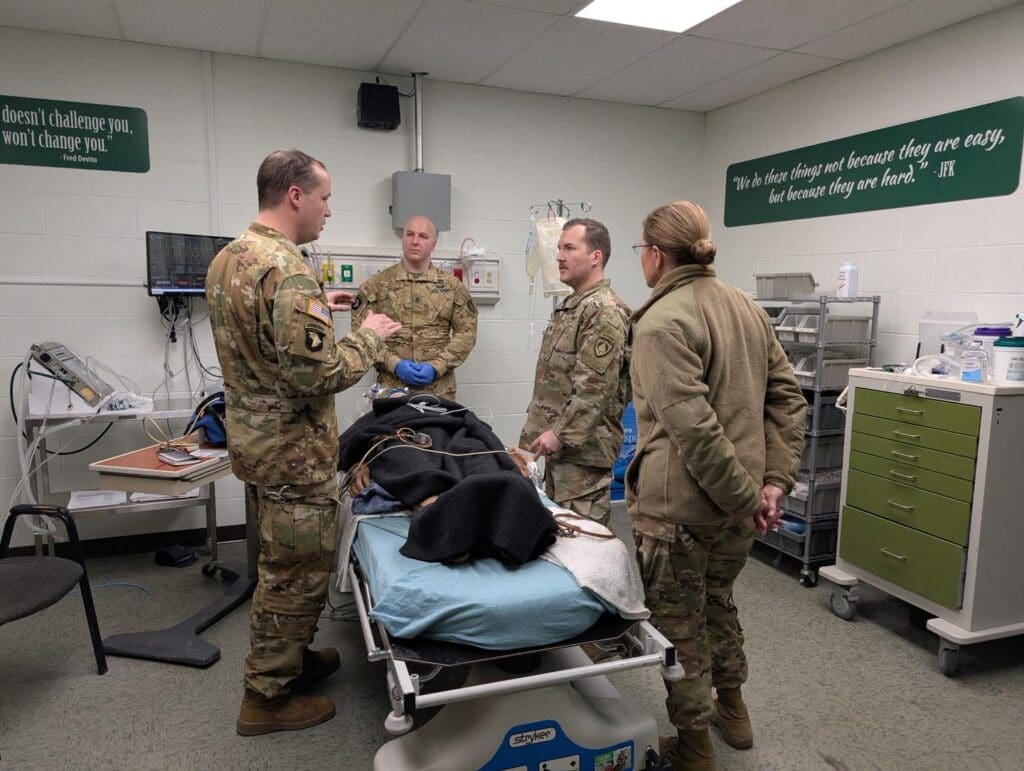
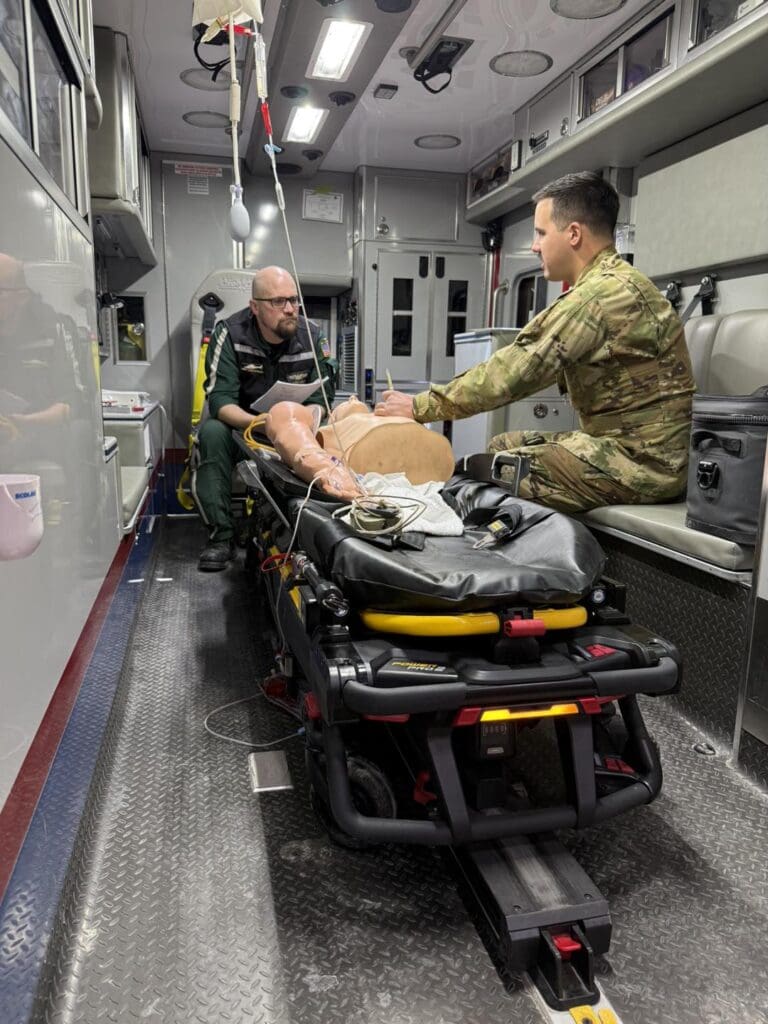
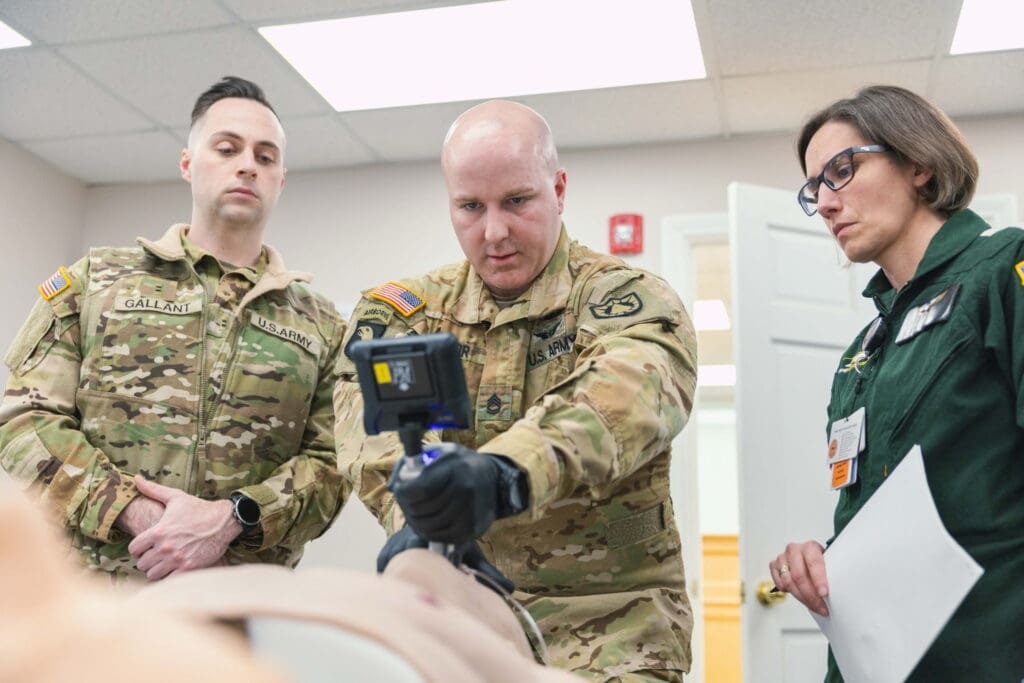
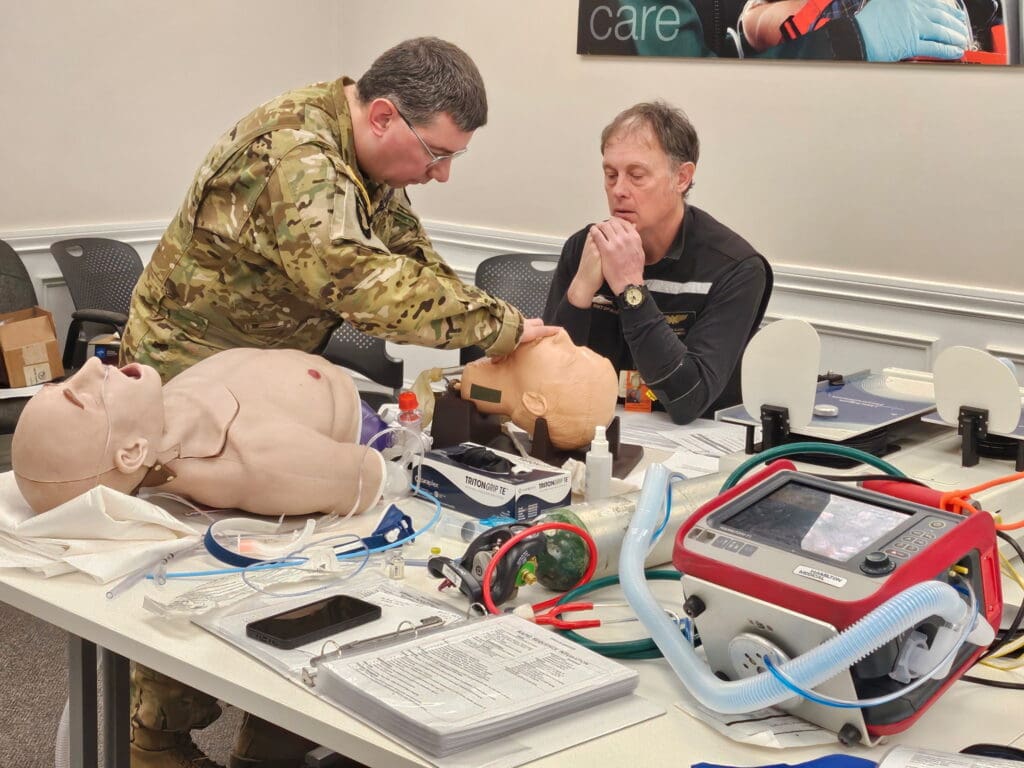
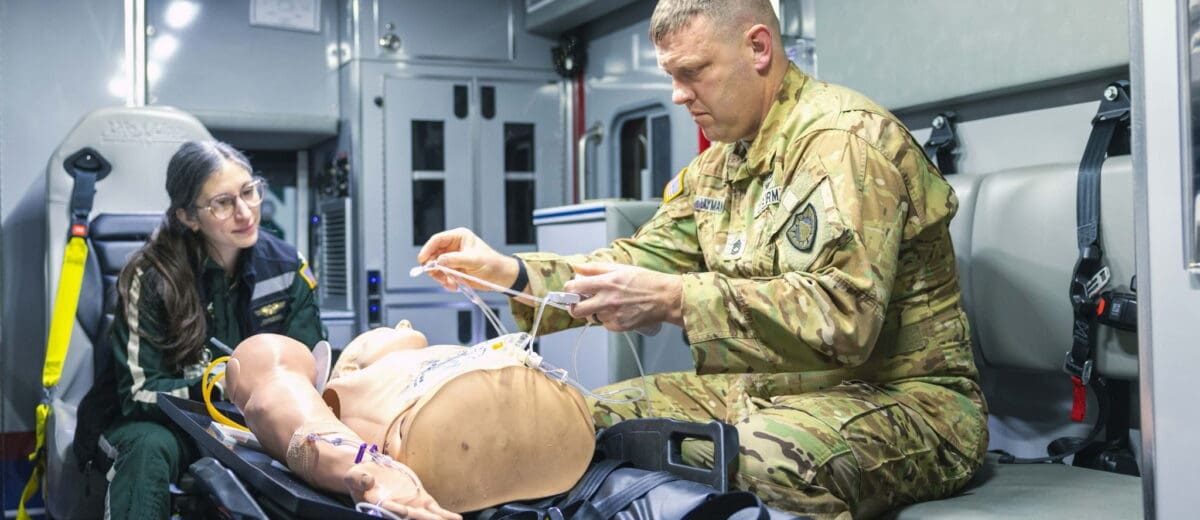
Army medics work with LifeFlight of Maine clinicians to validate their skills.
(Photos Courtesy: Maine Army National Guard)
Greg continued to learn new skills as a flight medic while part-time in the Guard. In the mid-2010s, the Army moved toward requiring flight paramedics to earn their FP-C as part of the transition to the Critical Care Flight Paramedic (CCFP) model. According to Greg, the shift was driven largely by lessons learned by the Army during the Iraq and Afghanistan wars. The Army now aligns its flight medics with civilian critical care transport standards.
In 2019, Greg was hired as a flight paramedic at LifeFlight of Maine. Like all new clinical team members, Greg received hundreds of hours of intensive, full-time orientation on a wide variety of medical and aviation disciplines. LifeFlight’s critical care medical teams have an expanded scope of practice that allows them to bring the trauma center directly to the patient, delivering ICU-level care on scene. To reach this level of expertise requires hours of hands-on training with veteran crew members and clinical educators.
Greg spent the next few years as a flight paramedic with LifeFlight, where he cared for Maine’s most critically ill and injured patients hundreds of feet in the air.
Simultaneously, Greg continued his commitment to the Maine Army National Guard and rose through the ranks there. In 2023, he was offered the opportunity to return to his original unit, G-3/126th MEDEVAC, as a Platoon Sergeant and Senior Medical Instructor. In his new roles, he manages training for the unit’s flight paramedics.
“I saw that as a great opportunity to come back to the unit and share my experience from LifeFlight,” said Greg. “My big picture goal is to create a training program that is a model for the rest of the Army to use to try to bridge the gap between the training they provide to medics and then building confidence on the job.”
In his instructional role, Greg is responsible for certifying to the Army that the flight medics in his unit know how to perform a set of required clinical skills.
Right across the runway from the Guard’s hangar is LifeFlight’s hangar. Greg knew LifeFlight had the equipment the Army flight medics needed to validate their skills, as well as clinicians with an expanded scope of practice who offer training to other EMS agencies.
“LifeFlight does an enormous amount of outreach with EMS agencies. We are in a good position to offer education to other agencies, and the military is seen as one of those agencies,” shared Greg.
Greg worked with the leadership team at LifeFlight to organize training with the Guard. The goal was to validate each Army medic’s skills, while also giving them the opportunity to receive individualized feedback from LifeFlight clinicians.
Over three days in February, Greg brought the Army flight paramedics to LifeFlight’s base in Bangor. Each Army medic spent time at three different stations, where they received one-on-one training from a LifeFlight clinician that covered an expansive range of topics. Army flight paramedics were validated on skills including rapid sequence intubation (RSI) and airway management, ventilator setup and management, IV/IO access and infusion pump operation, blood product administration, needle chest decompression and chest drainage system management, medical and trauma assessments, and hemodynamic monitoring setup and zeroing.
Instructors from LifeFlight included flight nurses Sarah Healey, Andrew Hughes, and Vernoica Marzonie. Flight paramedics Jessica Dorgai, Stephen Leavins, and Greg also led stations throughout the event.
“Overall, the training went very well. The structured rotation model and use of LifeFlight’s simulation resources allowed for consistent, high-fidelity evaluation across all participants,” said Greg. “In total, we trained more than a dozen flight medics from Golf Company 3rd Battalion, 126th Aviation Regiment (G-3/126th AVN (MEDEVAC)), with each completing all required validation stations as part of Table VIII Critical Care Skills Validation.”
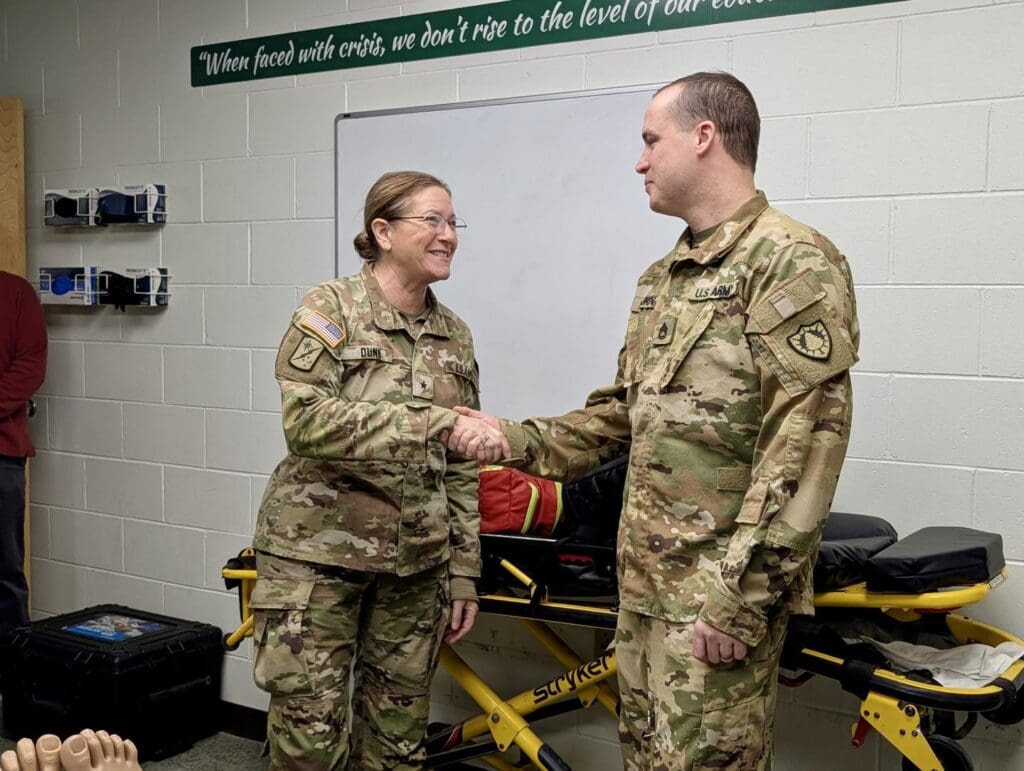
Greg invited leaders from the Maine National Guard to attend the training sessions to see first-hand the importance of the organizations working together. Attendees included Major General Dianne Dunn, Command Sergeant Major Alexander Clifford, Command Sergeant Major Timothy Tarrio, Command Sergeant Major David Gagne, Colonel Nathan Arnold, and Lieutenant Colonel Jon Bausman.
In February, Greg officially stepped into the role of Clinical Educator at LifeFlight. He will continue to regularly practice medicine on transports, but will also now spend time training new crew members at LifeFlight and sharing his expertise with EMS clinicians across Maine. In his new role, Greg hopes to expand collaboration between LifeFlight and the Guard.
“I definitely see this training as the very first step to open the door to an inter-organizational relationship that moves toward some really big ideas,” shared Greg.
(Photo Courtesy: Maine Army National Guard)