Patient Story: Kallaway Thebarge
“Wait. There’s a plane?” Lindsey Thebarge remembers thinking as she spoke with doctors about LifeFlight of Maine transporting her critically ill daughter, Kallaway, to an out-of-state hospital offering the specialized care she needed to survive.
Kallaway was eight years old, an aspiring and competitive gymnast, and until about two months prior had lived a perfectly normal life as an elementary school student in Madison, Maine. She had been in Missouri with her mother for a gymnastics camp. Something seemed off. Kallaway lacked her usual enthusiasm and energy. They chalked it up to too much heat and exercise, so she mostly watched her friends before traveling back home to Maine.
The next morning after traveling home from Missouri, Kallaway slept unusually late. By ten o’clock, Lindsey was getting worried and went to check on her. Kallaway was barely responding. Frantically, Lindsey and her husband tried to give Kallaway juice, but she wouldn’t drink it. They called 911 as Kallaway began to seize. Her blood sugar was at 41, which is dangerously low.
“Our house was filled with emergency response people,” Lindsey said. “When we got to Maine General there was a room full of doctors and nurses, and it was all hands on deck. They gave her a shot of glucagon, and it was like a light switch went on.” (Glucagon is a hormone that raises the body’s blood sugar, in much the same way that insulin lowers it.) They monitored Kallaway for a while, then sent her home to follow up with her doctor the following day.
In the week that followed, things spiraled quickly. “She was healthy, otherwise we never would’ve realized there was anything wrong with her,” Lindsey remembers. After being discharged from Maine General, Lindsey took Kallaway to see her pediatrician the following day. They still didn’t quite know what was causing Kallaway’s symptoms. She ended up back in the emergency room twice more that week.
With more questions than answers, Kallaway’s doctor referred her to an endocrinologist in Bangor. Her blood sugar was low and not leveling out, so the endocrinologist had her parents bring her to Northern Light Eastern Maine Medical Center (EMMC) where she was admitted.
Kallaway spent 18 days at EMMC with her care team trying to figure out what to do. She was diagnosed with hyperinsulinism, a rare condition in which the body produces too much insulin. Though extremely uncommon, it is most often diagnosed in infants and children. Too much insulin keeps the body’s blood sugar low. Kallaway’s endocrinologist had seen another case of hyperinsulinism when she worked in Boston. That patient had been sent to the Children’s Hospital of Philadelphia (CHOP), which has an entire unit specializing in this condition. The doctor spoke with Kallaway and her parents, and they decided to transfer her to CHOP.
Philadelphia is more than 500 miles from Bangor. Google suggests the trip might take eight and a half hours, but as you drive through every major city in the Northeast along the way, you’re unlikely to make it to Philadelphia in less than ten hours. And in July, with summer traffic in full swing, it could take even longer.
Kallaway needed to be stable enough to make that drive with her parents. She wasn’t. CHOP needed to have a bed available for her, so they also needed to wait for that.
On July 24, a bed became available at CHOP for Kallaway. It was time to go. “If you don’t go now, you’ll lose your bed,” Lindsey remembers the medical team at EMMC telling her. The physician in Bangor spoke with the medical team at CHOP, and they decided the best option was to transport Kallaway via LifeFlight.
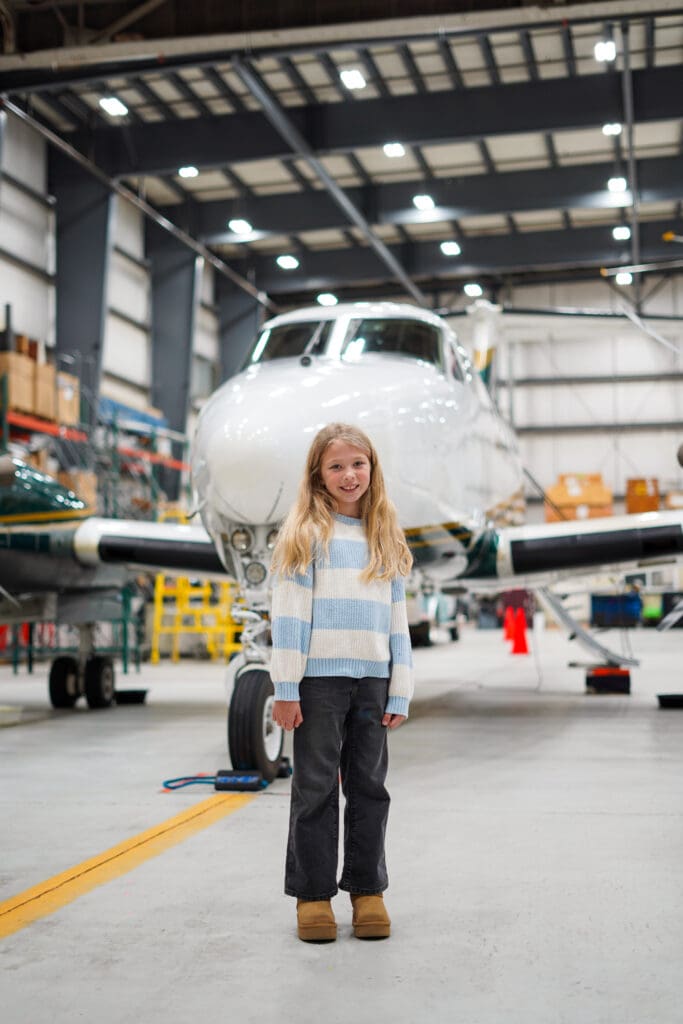
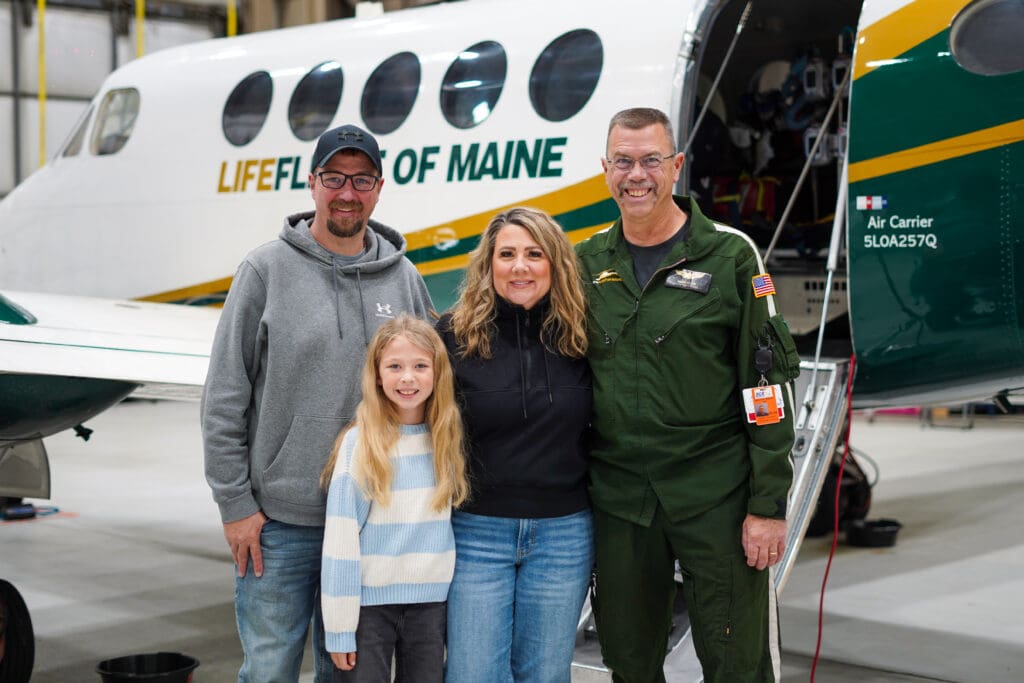
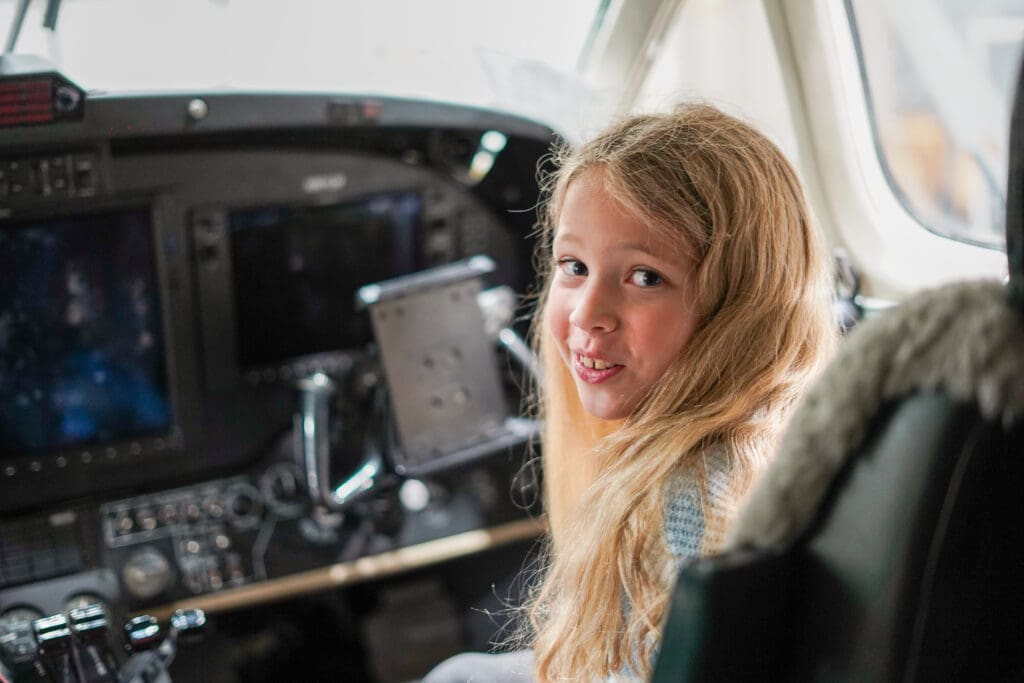
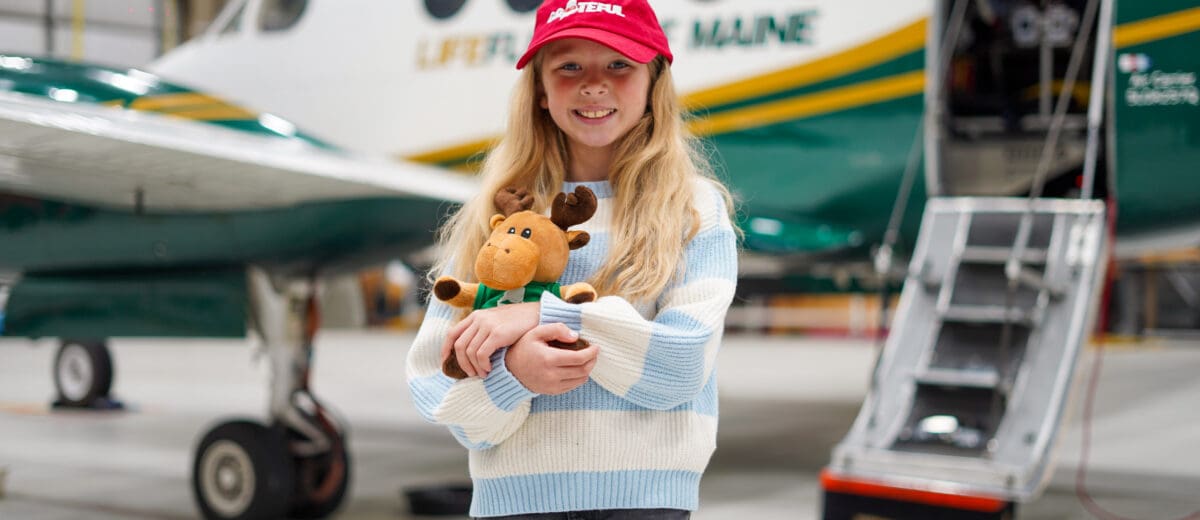
Lindsay and her parents visited the LifeFlight hangar in Bangor to see the clinicians who cared for her. Left: Kallaway in front of LifeFlight’s plane, Lima Mike. Middle: Kallaway, her parents, and Flight Paramedic Brent Melvin. Right: Kallaway in Lima Mike’s cockpit.
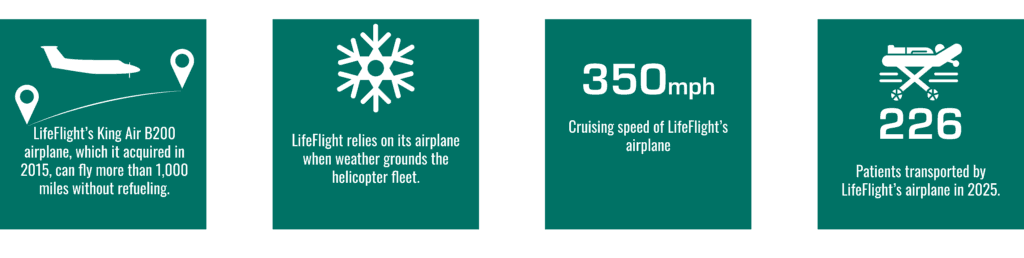
“When they showed up, we were all ready to go,” Lindsey said of meeting the LifeFlight crew. Flight paramedic Brent Melvin and flight nurse Morgan Greene came to Kallaway’s room at EMMC. They brought her down to an ambulance that was waiting, and drove her to Bangor International Airport, where LifeFlight’s King Air B200 airplane was fueled and waiting. “I didn’t even know you guys had a plane,” Lindsey said. She boarded the plane with Kallaway and the LifeFlight crew, and they took off for Philadelphia.
The LifeFlight team hadn’t yet figured out how they were going to get from Philadelphia International Airport to CHOP. LifeFlight’s dispatcher had called a few local ambulance companies in Philadelphia, but none were available. Still, there wasn’t time to wait. Kallaway had to get there, and the plane was already en route. “What are your thoughts on Ubering from the Philadelphia airport to CHOP?” Lindsey remembers Morgan asking as she explained the situation. “Brent and I will be with you, we’ll have the medications with us, and we’ll stay with you the whole way.”
What Lindsey remembers most about that trip is the compassion she experienced from the LifeFlight team. “They’re family now. I replay that day often, and it wouldn’t have gone as well without their comfort and support,” she said.
The LifeFlight crew made one last effort to find an ambulance, before hailing an Uber. They called CHOP and explained the situation. Frustrated, the doctor at CHOP made some phone calls and an ambulance was there waiting when Kallaway landed in Philadelphia. Brent and Morgan climbed in the back with her and they rode across town to the hospital.

Kallaway spent 29 days at CHOP. She turned nine in Philadelphia and had surgery on her pancreas the following day. She was discharged on August 21, took a commercial flight to Boston and then a train home to Maine. Her father picked them up at the station in Freeport and drove Kallaway and Lindsey home.
“She started school a week later in a new school with new friends, and she has shined so bright,” said Lindsey. In December 2025, four months after her surgery, Kallaway competed in a gymnastics meet. “She’s cured,” Lindsey said. “She can go back to the life of being a kid without having to watch her numbers.”
“This is a huge comeback for our family.”
You make stories like Kallaway’s possible.
LifeFlight depends on the generosity of its donors and supporters to equip its fleet. In the colder months, our airplane is a lifeline for Maine communities when winter weather grounds our helicopter fleet. Our airplane was purchased with philanthropic support more than ten years ago, and its continued operation would not be possible without our generous donors.
LifeFlight teams are available 24/7/365. We own and operate all of our own aircraft right here in Maine. We have aviation maintenance technicians who ensure each aircraft is maintained to the highest standards and is safe to fly on every shift. Our pilots hone their skills on our aircraft through regular training and review of their proficiencies, including operating with night vision goggles and in instrument flight conditions (i.e. navigating using instruments in the cockpit when visibility is low).
We employ some of the best, most experienced pilots and technicians in the country, because our commitment to safety and reliability is fundamental to our mission. Aviation technology continues to develop rapidly, and we are always at the forefront, adapting the latest tools to help us safely reach more patients in their moment of need.
Our Aviation Fund allows us to purchase this equipment, including military-grade night vision goggles, communications technology, advanced avionics, precision maintenance tools, and upgrades to the aircraft themselves. This fund also supports our performance-based navigation program, as well as training for our pilots and maintenance technicians to ensure they are knowledgeable about the latest technologies we are putting in our aircraft.