Patient Story: Mark Siner
“Had it not been for a LifeFlight pilot hearing a desperate plea for help, I would be a dead man.”
That was how Mark Siner greeted his LifeFlight crew about a year after he was crushed by a tree. The crew who cared for him wasn’t sure if he’d make it out of the hospital when they dropped him off. He had been given ten units of blood before the helicopter even landed at Dartmouth-Hitchcock Medical Center.
LifeFlight transports more than 2,500 patients on average every year. In 2025, crews transported more than 3,000. For some patients, coming to a base to meet and thank their crew is often a powerful component of their healing.
Mark’s LifeFlight story began on September 10, 2024. That day, he and his best friend were cutting down a tree on a miles-long dirt road in Thornton, New Hampshire. Both men are retired from the Vermont National Guard and are no strangers to dangerous work. Mark, who has years of experience cutting trees, reviewed the plan to take down the tree with his friend before starting the process.
“I started to cut, and the tree started to move. I put my saw down and I started quickly walking down my escape route. And we had cleared it of any brush and such, so I wouldn’t trip. We had it all planned out,” explained Mark.
“Well, the tree started to fall, and as it fell, the place where it was cracked broke in half, and the top part caught a branch from another tree and rolled sideways and backwards,” said Mark. “And like my friend said, ‘Mark, if the tree had eyes, it followed you down.’”
The tree fell directly on top of Mark, driving him into the ground, which, because it was New Hampshire, consisted mostly of granite boulders. Mark said he was immediately knocked unconscious.
When he regained consciousness, he could barely breathe and was in a lot of pain. His friend, who in a rush of adrenaline removed the tree from on top of Mark, had already called 911.“He said he doesn’t even know how he did it,” said Mark, regarding the heroic lift. “He kept me calm, and he kept talking to me.”
The Thornton police, followed by the Campton-Thornton Rescue, arrived on scene. Given the severity of Mark’s injuries, first responders called for an air medical transport. Mark was loaded into an ambulance and began the drive down the dirt road to the highway. His condition began to worsen. At that point, Mark’s care team knew he would not survive a long ambulance ride to a hospital with a higher level of care. Instead, they drove him to Speare Hospital in Plymouth, with hopes to connect with a critical care aircraft for a transport to a larger facility.
The Sanford, Maine based LifeFlight crew was the nearest available asset and was requested. A crew consisting of rotor wing pilot Tom McDevitt, flight nurse Kayla Jones, flight paramedic Paul Silva, and paramedic orientee Tommy Gallant landed on the helipad at Speare to transport Mark to Dartmouth-Hitchcock Medical Center.
When the crew arrived, they were informed of Mark’s condition and the care he had already received from EMS and the hospital staff. They did a rapid assessment and began to give Mark his first unit of blood. A second unit was given as the crew worked to intubate Mark.
“Following intubation, the crew was about to move forward to the aircraft. However, he became hypotensive again and with our last unit of blood being initiated, we knew he would not make the 14-minute flight without more,” remembered flight nurse Kayla Jones.
LifeFlight of Maine is the only EMS service in Maine allowed to carry and initiate blood and plasma therapies. On every call, crews bring two units of packed red blood cells and one unit of fresh, never-frozen plasma. All three of these units were used within the first fifteen minutes of caring for Mark.
“While Tommy and Paul got the patient ready for the move, I jumped out of the helicopter and went into the facility to notify the ER that we needed help,” said Kayla. The lab released more blood for Mark, and surgeons at Speare placed chest tubes to help with his breathing. Meanwhile, the ER doctor set up a receiving team at Dartmouth-Hitchcock.
“Despite not transporting patients from Speare frequently, the teamwork between flight crew, EMS, and hospital staff was amazing. While in the ER we were able to place bilateral chest tubes, an invasive blood pressure monitoring device called an arterial line, as well as more blood product. Once the patient was stabilized, we were able to leave for the 14-minute flight to Dartmouth Hitchcock hospital to meet the trauma team,” said Kayla.
From the moment LifeFlight clinicians stepped on scene to when they transferred care to Dartmouth-Hitchcock, Mark received 10 units of blood. This includes the two units that were given in flight. When they arrived at Dartmouth, the crew transferred care to the new medical team. Kayla called Mark’s wife, Kim, to update her on their arrival and Mark’s condition.
Mark spent four and a half weeks in the hospital and underwent seven surgeries. The accident left him with internal bleeding and a torn aorta. He also had a plethora of broken bones, including his spine, hip, ankle, tibia, scapula, and seven ribs.
He then spent two additional weeks at Encompass Health Rehabilitation Hospital of Concord after he was discharged from the hospital. He continues to do physical therapy and occupational therapy. His resilience and grit played a big role in his ability to recover as quickly as he did. “It was another challenge,” said Mark. “My military background was for sure a big help.”
As Mark healed, he decided he wanted to give back to the people who helped save his life. “I finally said, ‘I need to contact that pilot, I need to contact that crew and do something to say thanks,’” said Mark.
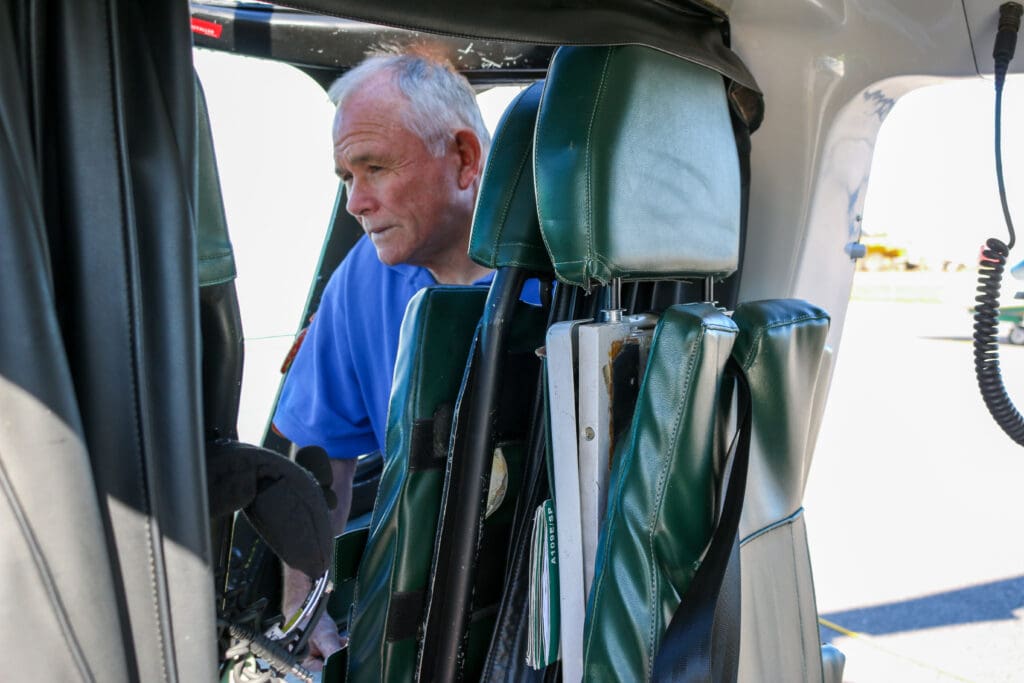
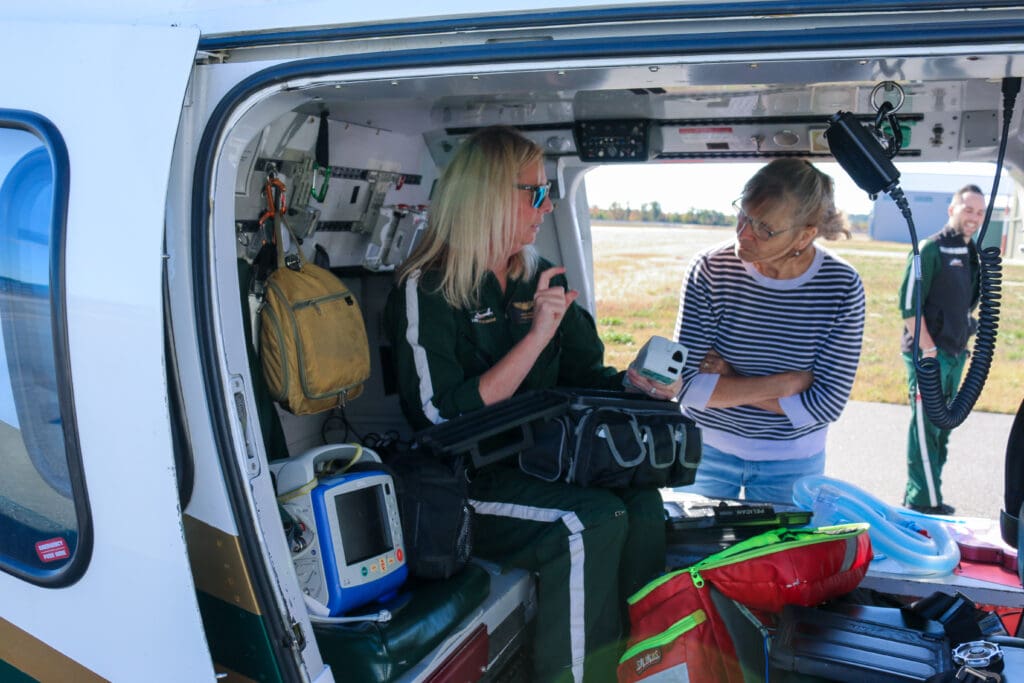
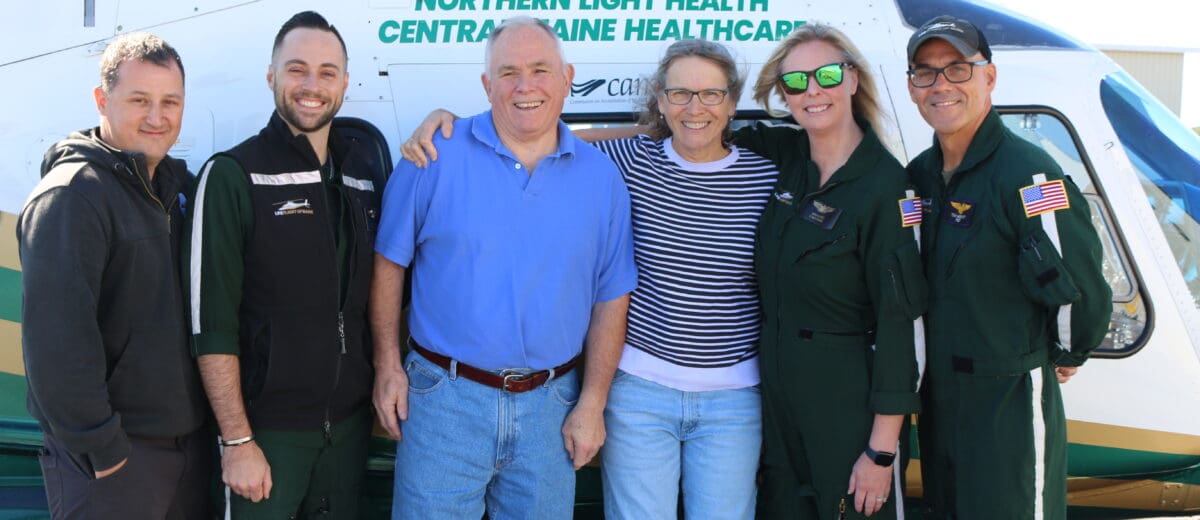
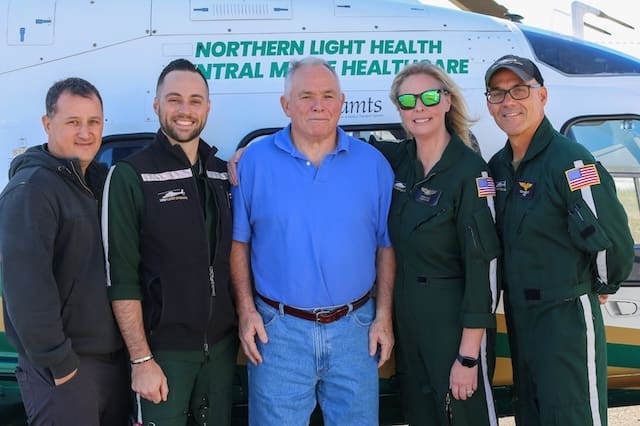
So, in early October 2025, just over a year after his flight crew dropped him off at Dartmouth-Hitchcock, Mark and Kim walked into the LifeFlight of Maine hangar in Sanford. The crew greeted them with smiles and hugs, happy to see their former patient — whom at the time they had not been sure they would see again — walking on his own and back to his spirited self. Together, they shared some memories of that day in New Hampshire and the road to Mark’s incredible recovery.
“It’s not often we get updates on our patients after we care for them,” said Kayla. “Being able to see Mark have a chance at recovery and to be able to make many more memories with his family… there are no words for how that feels.”
Mark’s transport was an example of different pieces of the health care system working in unison to achieve a great outcome.
“From first responders and early flight activation to smaller critical care access facilities willing and able to rise to the call of assistance, we were all working together for one common goal,” said Kayla. “I know that LifeFlight is an important connection point in healthcare, especially in our rural New England areas, and that we were his best chance at getting to the definitive care he ultimately needed. I am proud to work with my crewmates every day. Our connection as a team is incredible, there is nothing else like it.”